Writing

A numbered series on Africa's public institutions — what's broken, what works, and what the evidence says. Each paper carries a stable WP number and is citable from the Flux registry.

Showing 2 of 44

2026

WP06
The Offline-First Problem: Why Most Institutional Software Fails in the Field
Abstract

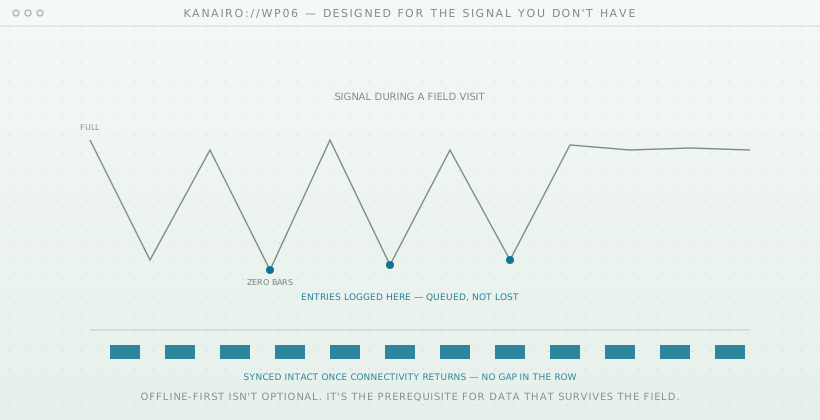
Most institutional software deployed in African field settings fails for a shared, architectural reason: it assumes continuous connectivity that does not exist where it is meant to operate. This revision adds a scope section distinguishing the paper's architecture argument from a measured outcome; grounds "offline-first" in the published local-first software literature (Kleppmann et al., Onward! 2019) and the well-established CAP/eventual-consistency trade-off (Vogels, CACM 2009) — while being explicit that both were developed for personal and creative cloud apps, not institutional field software, so the architecture transfers but the original evidence base does not; places Flux's own unaudited field-deployment data (AccessWASH, BungeConnect) alongside regional connectivity statistics (GSMA's 13% Sub-Saharan Africa coverage gap and 60% usage gap, 2023) and Kenya's supply-side mobile-subscription data (Communications Authority of Kenya, June 2025), clearly separating what each does and does not measure; and adds one independent, peer-reviewed confirmation from a different African sector — a 2021 account of mobile data collection during an immunisation programme review across East and Southern Africa, where intermittent connectivity delayed submission and an offline-first queue prevented data loss. An earlier, unsourced claim about Kenyan rural power outages correlating with connectivity outages is now stated as a plausible, unverified mechanism rather than fact. Objections (including Flux's commercial interest in both products discussed), falsification conditions, limitations, and both appendices are added. Three measurements the argument needs and lacks — the share of African institutional software failures actually caused by connectivity-architecture mismatch, an independent audit of Flux's own field data, and the Kenya-specific power/connectivity correlation — are registered CITATION-NEEDED rather than estimated.
28 Mar
22 min
paper ↗
WP02
Africa's Institutions Don't Have a Funding Problem
Abstract

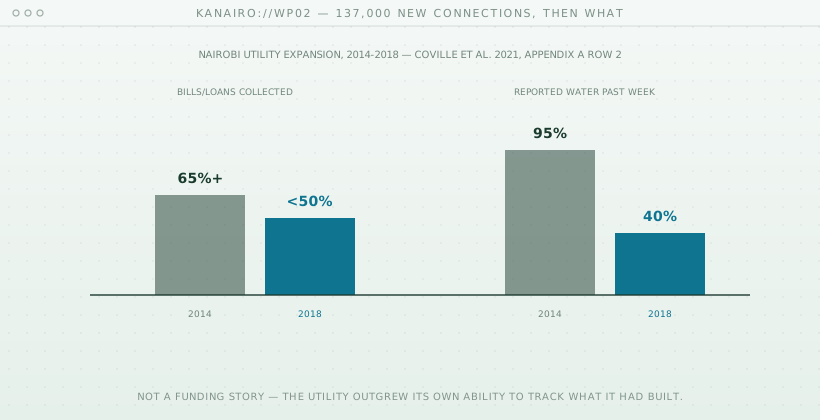
This paper revisits the claim that Africa's public institutions fail primarily from missing software tools rather than corruption or underfunding, and is more careful than the original body about what that claim can and cannot carry. It replaces an unverifiable "~45% average, 21 counties exceeding 50%" non-revenue-water figure with Kenya's water regulator's current sector report (44% national average, 25% benchmark, a 28%-75% county range), and replaces an unverifiable "10 to 15 times" water-vendor price multiple with the honest range reported across disagreeing secondary sources. A new section built around a World Bank field experiment on a Nairobi utility's own administrative billing data supplies the paper's most rigorous evidence and its sharpest complication: after a 2014-2018 informal-settlement connection expansion, revenue collection collapsed from above 65% to below 50% despite the connections being tracked well enough for the study to happen at all — what ultimately restored payment was a specific enforcement process, not visibility alone, which narrows this paper's "give institutions tools" thesis to something more precise. The AccessWASH and BungeConnect numbers are now stated plainly as Flux's own unaudited account, including a United Nations recognition claim that could not be independently corroborated in this pass. A new objections section engages Flux's commercial interest directly and takes seriously Kentaro Toyama's "law of amplification" — that technology amplifies existing institutional capacity and intent rather than substituting for it, which cuts against this paper's optimism for institutions where intent, not tooling, is the actual constraint. Falsification conditions, limitations, and both appendices are added. Two measurements the argument needs and lacks — an independent audit of Flux's own product claims, and the share of institutional underperformance actually attributable to missing tools versus corruption or underfunding — are registered CITATION-NEEDED rather than estimated.

28 Jan
25 min
paper ↗