Writing

A numbered series on Africa's public institutions — what's broken, what works, and what the evidence says. Each paper carries a stable WP number and is citable from the Flux registry.

Showing 3 of 44

2026

WP44
The Interface Tax: What a 1990s Signalling Protocol Still Costs Kenya, in Hours
Abstract

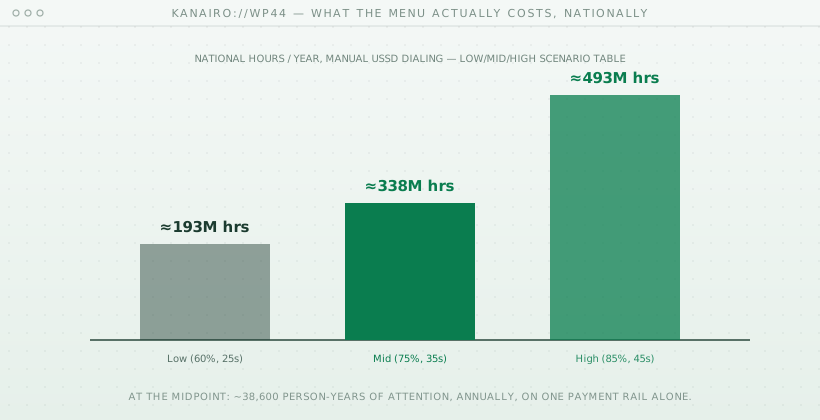
USSD — the star-and-hash menu, not an app — still carries the large majority of Kenya's mobile-money transactions, for sound economic reasons: it needs no data, no smartphone, and almost no onboarding cost, and it is dramatically cheaper for an operator to run than an app. None of that is in dispute. What has never been added up is the other side of the ledger: the aggregate human time a population spends navigating that menu, one twenty-to-forty-five-second session at a time, multiplied across tens of millions of people and tens of billions of transactions a year. This paper borrows a framework built for an entirely different context — Herd and Moynihan's theory of administrative burden, developed to describe citizens' friction with the state — and applies it to a private payment rail instead, then builds a transparent, source-anchored estimate of what that burden actually totals, nationally and per person, with every assumption shown rather than hidden inside one confident number.
14 Oct
10 min
paper ↗
WP38
The Chargeback Assumes a Human
Abstract

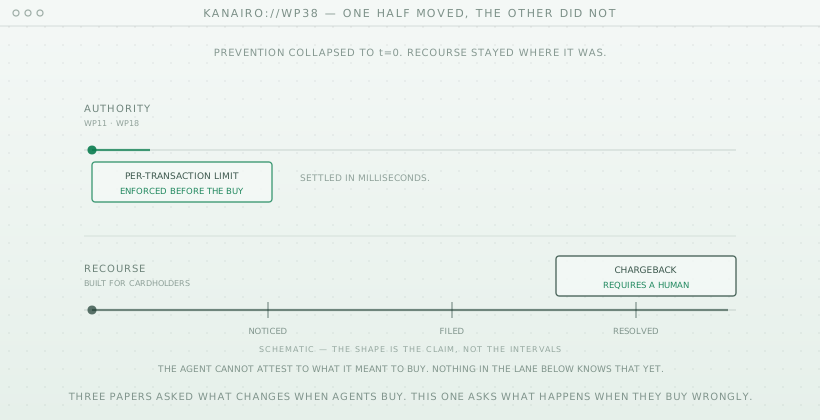
The Flux procurement trust series argues across three papers that spending control is migrating from after a purchase to before it. Each assumes the purchase succeeds. This paper examines the failure case and argues that prevention has collapsed to the instant of payment while recourse has not moved, because the dispute mechanism is evidentiary rather than financial and is built around a participant the transaction no longer contains. The gap sits in the definitional layer, not the procedural one: the controlling United States definition of an unauthorised electronic fund transfer turns on initiation by a person other than the consumer, without actual authority, yielding the consumer no benefit — and expressly excludes transfers initiated by anyone the consumer furnished with means of access. A correctly deployed agent that buys the wrong thing satisfies every limb, so the mechanism does not fail but declines to engage. Four consequences follow: intent is distributed across a goal, a policy, a model selection and an instrument, with no addressee; the agent's timestamped log is superior evidence the process has no slot for, because admitting it would reintroduce the investigation cost the design exists to avoid; scoped credentials improve prevention precisely by detaching the transaction from a named person; and continuous transacting removes the occasion for human detection. The paper surveys what the card schemes have actually shipped, argues that assigning liability to the deployer provides no remedy and mistakes the common case of a non-delivering seller, and sketches three properties agent-appropriate recourse would require. No pilot is reported.

14 Sep
22 min
paper ↗
WP04
Why Africa Needs Stablecoin Rails Before It Needs a Digital Currency
Abstract

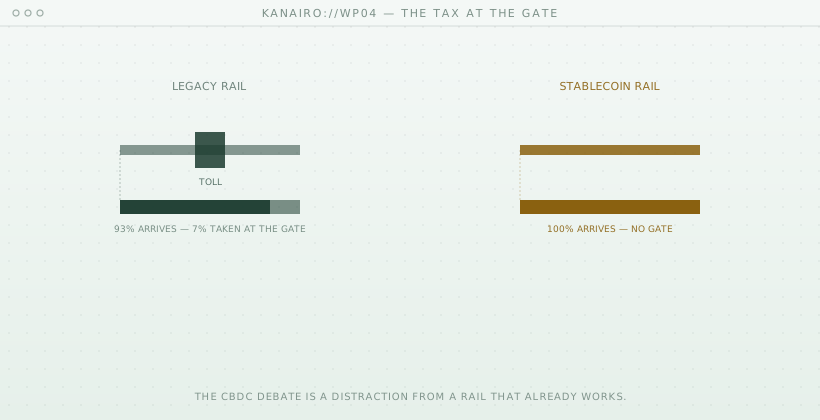
This paper argues that stablecoin-native payment rails, not central bank digital currencies, are the more immediate and tractable fix for African institutional finance — utilities, cooperatives, and community organisations whose cross-border settlement, treasury, and reporting needs are poorly served by both legacy correspondent banking and retail-focused CBDCs. This revision adds a scope section distinguishing the paper's architectural argument from a measured outcome; re-verifies the World Bank's remittance-cost data (8.78% Sub-Saharan Africa average versus 6.49% global, Q1 2025) and, in a genuine complication for the paper's own framing, reports an independently sourced figure for the US-Nigeria corridor (≈2.94%) sharply below the regional average, rather than repeating several per-corridor figures from the prior body that could not be re-verified in this pass. It grounds the paper's central CBDC/stablecoin distinction in Nigeria's own published eNaira first-year results (IMF Working Paper 2023/104: under 1% of active bank accounts onboarded, 98.5% of wallets unused weekly) while being explicit that one retail-focused design is not proof against an institution-focused CBDC. A new objections section engages stablecoin risk directly and without softening: TerraUSD's 2022 algorithmic collapse, Tether's 2021 New York settlement over false reserve claims, and the Bank for International Settlements' "singleness of money" critique of stablecoins generally. Flux's commercial interest in the conclusion, through its own product PesaRails, is named directly. Falsification conditions, limitations, and both appendices are added. Three measurements the argument needs and lacks — measured settlement-cost reduction for institutions actually using stablecoin rails, Kenya/East Africa's regulatory position on institutional stablecoin custody, and verified per-corridor remittance costs beyond the two confirmed in this revision — are registered CITATION-NEEDED rather than estimated.

26 Feb
22 min
paper ↗